Why Your First Alcohol Free Holiday Weekend Is Harder Than a Normal Week
Quick Answer: Ordinary weeks are held together by structure — work, timing, routine, and a limited set of cues. A holiday weekend removes all of that at once while multiplying the situational triggers: unstructured time, social pressure, celebration framing, and a different environment. It is not a loss of resolve; it is the removal of everything that was quietly doing the work. Planning the specific moments in advance is what carries you through.
Your routine was not weak. It was context dependent, and the context just changed.

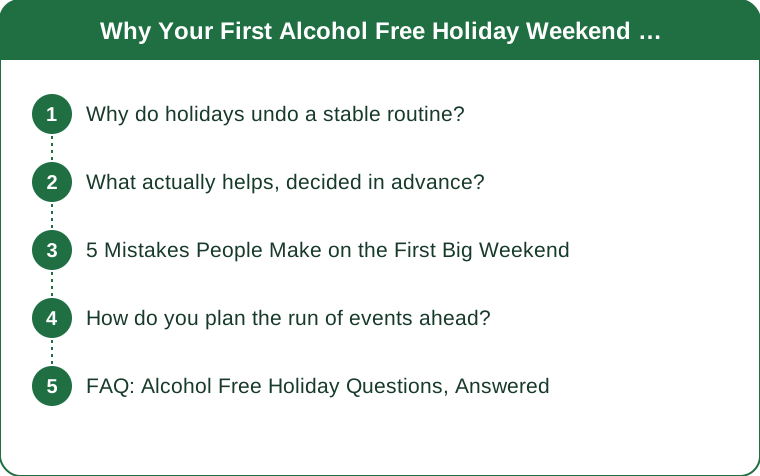
Why do holidays undo a stable routine?
Because habits are cue driven, and a holiday deletes and replaces almost every cue at once.
Habit research is clear that behaviour is strongly tied to context: time of day, location, the people present, the preceding action. A stable weekday routine is stable partly because the cues repeat, and your response to each has been rehearsed dozens of times.
A long weekend removes them wholesale. Different location, different timing, different people, no work anchor, and no fixed structure to the day. The habits you built have nothing to attach to.
Meanwhile the number of triggers rises sharply:
Unstructured time, which is the single largest predictor of difficulty for most people. Social gatherings where drinking is the default, and where declining requires an active choice repeatedly rather than once. Celebration framing, which reclassifies drinking as marking an occasion rather than a habit. Other people’s schedules, which means less control over when and where you are. And often disrupted sleep and eating, both of which reduce the resources available for anything difficult.
There is a specific effect worth naming. Being offered a drink repeatedly is much harder than deciding once. Each offer is a fresh decision point, and decision fatigue is real. Fifteen small refusals over an afternoon cost more than one big one.
So the honest framing is that a holiday weekend is a harder test than several ordinary weeks combined, and treating it as equivalent is what catches people out.
What actually helps, decided in advance?
Concrete plans for specific moments, because in the moment is exactly when this is hardest.
Decide your answer before you are asked. One short sentence, prepared, that you do not have to construct under mild social pressure. Not drinking tonight, or I am driving, or just water for me thanks. The specific words matter less than having them ready, because the difficulty is in composing a reply while everyone is looking at you.
Arrive with a drink in your hand. The single most effective practical trick, and it is almost too simple to believe. A visibly full glass eliminates most offers before they happen, and people stop noticing entirely.
Know what you are drinking and make sure it exists. Bring it if necessary. Turning up hoping something appealing will be available is how people end up with a warm soft drink and a sense of deprivation, which is a poor state to be in for several hours.
Set an exit point in advance. Knowing you are leaving at nine makes the whole evening easier, because you are not managing an open ended commitment. You can always stay longer, and having the option decided removes most of the pressure.
Keep one anchor from your normal routine. A morning walk, the usual coffee, whatever it is. Having one part of the day that behaves normally holds more than it sounds like it would, because it gives the unstructured day a spine.
Tell one person. Someone at the event who knows means you have somewhere to stand and someone who will not ask twice.
Eat properly and sleep as normally as you can. Both are boring and both matter, and both go first on a holiday weekend.

5 Mistakes People Make on the First Big Weekend
1. Assuming it will be like a normal week. It is a substantially harder situation with fewer supports, and going in without a plan on the grounds that the last six weeks were fine is the most common error there is.
2. Not planning what to drink. Arriving with no alternative sorted out means standing empty handed, fielding offers, and feeling like the odd one out. This one is entirely preventable and it derails more weekends than social pressure does.
3. Committing to the whole event with no exit. An open ended afternoon that turns into an open ended evening is very different from a planned three hours. Deciding the exit in advance is what makes the rest of it comfortable.
4. Testing yourself unnecessarily. There is no prize for attending the hardest possible event in the first months. Skipping one gathering is a legitimate strategy, not a failure, and it is often the right call early on.
5. Treating a slip as the end of the project. If it happens, the thing that determines the outcome is what happens next, not what happened. Most people who sustain this long term have had setbacks, and the ones who continue are the ones who resume immediately rather than writing off the effort.
How do you plan the run of events ahead?
By looking at the calendar now, because the next few months contain more of these than any other part of the year.
The autumn and winter run is the densest social period of the calendar. Late summer holidays, then the run of autumn gatherings, then the long stretch of end of year events. For anyone in their first year, this is the hardest sequence they will face, and it arrives as a series rather than as isolated occasions.
What helps, specifically:
Look at the whole run rather than the next event. Knowing there are four gatherings in six weeks changes how you plan, because it is a campaign and not a single evening. Energy spent well on the first one leaves more for the rest.
Decide in advance which ones you will attend fully, which briefly, and which not at all. All three are valid. Deciding calmly beforehand is far better than deciding at five in the afternoon when you are already tired.
Front load the easier ones. Attending a couple of low pressure events early builds genuine evidence that you can do this, which makes the harder ones later feel different.
Watch the seasonal darkness. Evenings get dark early through autumn, and for a lot of people that shifts mood and increases the pull toward drinking as an evening activity. This is worth anticipating rather than being surprised by, and a plan for the dark five to seven window is worth having.
Build a genuine alternative for the evening slot. Something you actually look forward to, rather than an absence. This is the part most people skip and it does more than the refusals do.
And one thing that needs saying directly: if you drank heavily or daily, stopping abruptly can be medically dangerous, and alcohol withdrawal is one of the few withdrawals that can be life threatening. This article is general information about social situations and habit change, not medical advice. If you are drinking heavily, if you have experienced shaking, sweating, or worse when you stop, or if you are finding this genuinely difficult to manage, talk to a doctor. There is real support available and it works better than doing it alone.
FAQ: Alcohol Free Holiday Questions, Answered
What do I say when someone keeps offering?
Something short, said the same way each time, without an explanation. Explanations invite discussion. Not drinking tonight, thanks, delivered lightly and repeated identically, ends it faster than any reason.
Is it fine to just not go?
Completely. Skipping an event in your first months is a strategy, not an avoidance problem, and most people who do this long term have skipped things early on and gone back to them later without difficulty.
Why is unstructured time so hard?
Because habits are anchored to cues, and an open day has almost none. Adding a small amount of structure — a planned walk, a set meal time, one thing at a fixed hour — restores more than it seems it should.
What if I slip?
Resume immediately, and try to learn what the specific trigger was, because it is usually a situation rather than a general weakness. What happens over the following week matters much more than the single evening does.
TL;DR:
- Ordinary weeks are held together by structure and repeating cues, and a holiday weekend removes all of them at once.
- Repeated small refusals are harder than one big decision, so prepare a single short line and reuse it.
- Arrive with a drink in hand, know your exit time in advance, and keep one piece of your normal routine intact.
- Plan the whole autumn run of events rather than the next one, and decide now which you will attend fully, briefly, or not at all.
Before the next gathering, sort out two things: what you are drinking, and what time you are leaving. That is most of the work.
Keep Reading
This article is for general informational purposes only and is not medical advice. Always consult a qualified health professional for guidance specific to you.