How to Handle Your First Autumn Social Season Without Drinking
Quick Answer: Autumn is harder than summer because events cluster, move indoors and last longer, and because the people asking why you are not drinking are people you see repeatedly rather than once. Three things do most of the work: have a drink in your hand from the moment you arrive, have one short answer you can say without thinking, and decide your exit time before you leave the house. Everything else is easier than the anticipation suggests.
You got through the summer fine, mostly because it was barbecues and daylight.
The autumn calendar is a different shape entirely, and it starts in about three weeks.

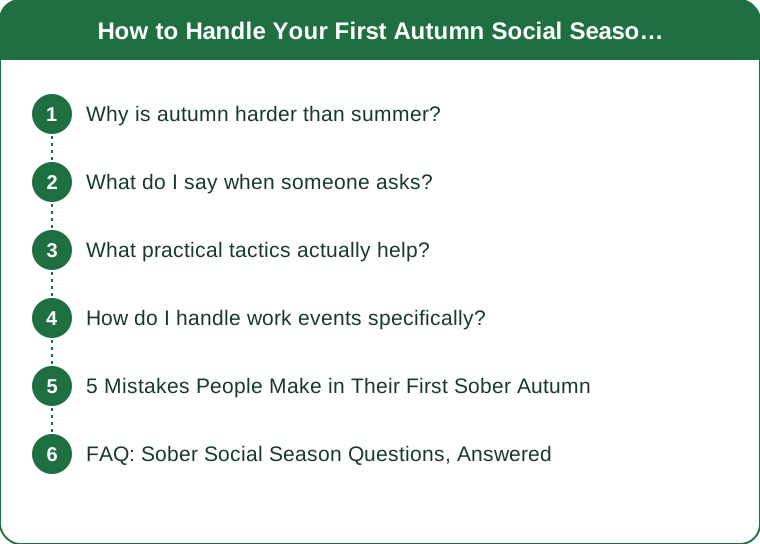
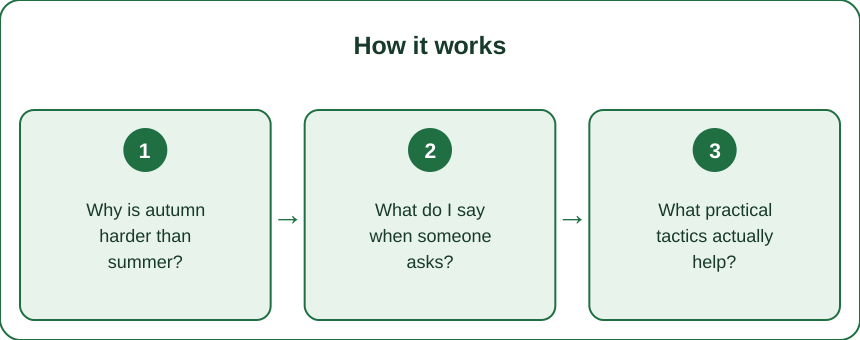
Why is autumn harder than summer?
Events get denser. The autumn and winter run of birthdays, work events, seasonal gatherings and holiday parties packs more occasions into fewer weeks.
Settings move indoors, where drinking is more central to the event and where there is less to do besides talk and drink.
Events last longer. A summer afternoon gathering has a natural end; an indoor evening event does not.
The people are more repeated. Summer often means one-off events; autumn means the same colleagues, family and friends multiple times, so the same conversation can recur.
Darkness and weather reduce the easy exits, since leaving early is less natural when nobody is drifting off into an evening outside.
And the seasonal mood shift is real for many people, which is worth acknowledging rather than treating as unrelated. This is general information, not medical advice.
What do I say when someone asks?
Have one short answer prepared and use it every time. Consistency is what makes it a non-event.
Short is better than honest. Not drinking tonight, driving, on antibiotics, taking a break - all work. You do not owe anyone an explanation.
The mistake is elaborating, because a long answer invites a discussion and a short one closes it.
Say it lightly and change the subject in the same breath. Most people are asking out of habit, not interest, and they move on immediately if you do.
Repeat pressure is rare and is usually about the other person, not about you. A second decline in the same tone almost always ends it.
And if you want to be direct about it, be direct - plenty of people simply say they do not drink, and it lands as unremarkable far more often than the anticipation suggests.
What practical tactics actually help?
Get a drink in your hand within a minute of arriving. An empty hand is a prompt for offers; a full glass ends the question before it is asked.
Arrive with a plan for what you will order, because deciding at a bar under social pressure is harder than deciding in your kitchen.
Bring something you like if you are going to someone’s house, which guarantees there is an option and removes the awkwardness of being offered water.
Decide your exit time before you leave. Most difficulty arrives late, so leaving at a chosen time rather than an exhausted one changes the whole experience.
Eat properly beforehand, which sounds unrelated and matters a lot - low blood sugar makes everything harder.
And have a get-out arranged - a lift, a booked taxi, an early start tomorrow. Having an exit available means you rarely need it.

How do I handle work events specifically?
Work events are the hardest category because you cannot fully choose the company and because the same people will be there next month.
Arrive on time and leave at a reasonable point, which is easier at work events than at social ones because leaving is normal and expected.
Position yourself where there is something to do - near food, near a group in conversation, in a task if there is one.
Have a role if you can. Offering to help, to take photos, or to organise something gives you a reason to be moving.
You do not have to disclose anything at work, and short answers are entirely sufficient.
And know that the first one is the hardest. After a colleague has seen you not drinking twice, it stops being a topic entirely.
5 Mistakes People Make in Their First Sober Autumn
1. Going to everything to prove it is fine. You do not have to attend every event to demonstrate anything. Choosing which invitations to accept is a legitimate strategy, not an admission of weakness.
2. Arriving with no plan for a drink. Standing at a bar with an empty hand deciding what to order is the single most uncomfortable minute of the evening, and it is entirely avoidable by deciding in advance.
3. Staying as late as you used to. The last hour of an event is when everyone else has been drinking for four hours and the conversation quality drops. It is also when it feels hardest. Leave before it.
4. Explaining too much. A long explanation invites debate and makes it a topic. A five-word answer makes it a non-event. Shorter is genuinely kinder to yourself.
5. Not having anything to look forward to afterwards. Alcohol-free evenings mean early, clear mornings, and having something you actually want to do with them turns the trade into a benefit rather than a loss.
And the honourable mention: treating one difficult evening as evidence about the whole project. Some events are hard. That is information about the event, not about you.
FAQ: Sober Social Season Questions, Answered
What should I actually order?
Soda and lime, tonic with bitters, an alcohol-free beer, a non-alcoholic spirit and tonic, or sparkling water with something in it. Something that looks like a drink reduces questions considerably.
Are alcohol-free beers and spirits a good idea?
Many people find them useful for the ritual and the social camouflage. Some people find they trigger cravings. It is individual - try one in a low-pressure setting first. If you are in recovery, discuss it with your support network or a healthcare professional.
How do I deal with someone who keeps pushing?
Repeat the same short answer in the same tone, then change the subject or move. Persistent pressure is about them, and you are under no obligation to explain further or to stay in the conversation.
Will I enjoy events less?
Some events, honestly, yes - particularly ones whose main activity is drinking. Many people report enjoying others more, and the mornings afterwards considerably more.
Should I tell people in advance?
You do not have to. Some people find a quick heads-up to a host removes the whole issue; others prefer not to make it a subject. Both are fine.
What if I slip?
One evening does not undo the work. Treat it as information about what makes things harder for you, and continue. If drinking is causing serious problems in your life, speak to a healthcare professional or a support service - there is good support available and reaching out early is worth doing. This is general information, not medical advice.
TL;DR:
- Autumn is denser, more indoor and more repetitive than summer, which is what makes it harder.
- Get a drink in your hand within a minute of arriving.
- Have one short answer and use it every time - elaborating invites debate.
- Decide your exit time before you leave the house.
- Eat properly beforehand and arrange a way home in advance.
- You do not have to attend everything, and you owe nobody an explanation.
The anticipation is consistently harder than the evening. This is general information, not medical advice.
Keep Reading
This article is for general informational purposes only and is not medical advice. Always consult a qualified health professional for guidance specific to you.