What to Do When Someone Keeps Asking Why You're Not Drinking
Quick Answer: Answer the first question briefly and without a reason, because a reason invites negotiation. If it repeats, name the repetition rather than answering again — “you’ve asked me a few times, I’m good” — which shifts the conversation from your drink to their persistence, and almost always ends it. Save any real explanation for people who genuinely deserve one, which is a much shorter list than the evening suggests.
The repeat asker is not looking for information.
Which is why giving more information does not stop them.

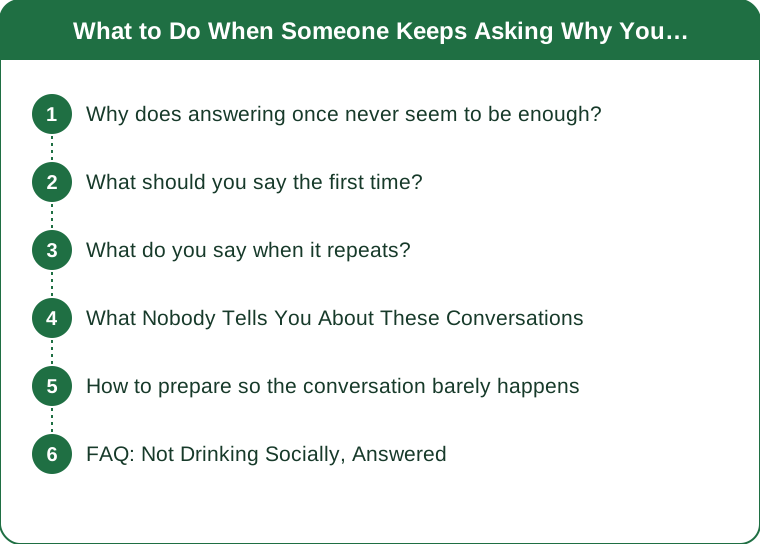
Why does answering once never seem to be enough?
Because the repetition is usually driven by something other than curiosity.
Most repeat questioners fall into one of four categories:
The host. Genuinely worried you are not enjoying yourself, and treating drinks as hospitality. This one is well-intentioned and responds instantly to reassurance about the evening rather than about the drink.
The uncomfortable one. Your not drinking has made their drinking visible to them. That discomfort comes out as questions, jokes and persistence. Nothing you say resolves it, because the issue is not about you.
The one who has had several. Repetition here is not strategy, it is just alcohol. They may not remember asking, and there is no point treating the fourth ask as escalation.
The genuinely curious. Interested in the topic, badly timed. This is the only category where a real conversation is worth having, and it is better had another day.
The reason a good answer does not work is that only the last category was asking a question. For the other three, more explanation gives them more surface to respond to, which extends the interaction rather than ending it.
This is why the effective responses below are shorter than most people’s instinct, not longer.
What should you say the first time?
Something short, warm and complete. A complete sentence closes; an explanation opens.
These work:
“Not tonight, thanks.” — The default. No reason, no apology, entirely unarguable.
“I’m driving.” — Ends conversations instantly and requires nothing further. Only use it if true, because being caught out is worse than the original question.
“I’m good with this one.” — Deflects to what you are holding rather than what you are not.
“Taking a break from it.” — Honest, low-detail, and it works for anything from a month off to permanently.
“Early start tomorrow.” — Universally accepted, requires no follow-up.
What to avoid on the first ask:
Anything that opens a negotiation. “I’m trying to cut down” invites “one won’t hurt”, and now you are debating.
Anything requiring defence. Health reasons, dry month challenges and detailed explanations all give a persistent person things to respond to.
Apologising. “Sorry, I’m not drinking” frames it as a failure of participation.
The key structural point: have something in your hand. An empty hand is an open invitation, and it is the single most effective piece of preparation available. Get a drink you like as soon as you arrive and keep it topped up.
What do you say when it repeats?
Change the subject of the sentence. Stop answering about your drink and start naming the pattern.
Second ask: repeat your first answer, verbatim, with a smile. Do not vary it, do not add anything. Adding detail signals that the first answer was negotiable.
Third ask: name it lightly. “You’ve asked a few times — I’m all good, honestly.” This is the pivotal move. It is friendly, it is not an accusation, and it makes the repetition visible. Most people stop immediately, because until you named it they had not noticed they were doing it.
Fourth ask: name it more directly, still warmly. “I’m genuinely fine. Can we talk about something else?” Explicit redirection, no hostility.
Beyond that: move. Go and talk to someone else, go to the bathroom, get some air. You are not obliged to stay in a conversation you have twice asked to change, and physically relocating is faster and cleaner than escalating.
A note on humour: a light joke works well for one exchange and poorly as a repeated strategy, because it keeps the topic alive. If you have deflected with a joke twice, switch to naming it.
And on the person who is loudly insistent in front of a group — the most uncomfortable version — the short answer plus turning to someone else and asking them a question is remarkably effective. You have not conceded anything and the group’s attention moves on.

What Nobody Tells You About These Conversations
Most people ask once and immediately forget. The dread is almost always larger than the reality. Ask anyone a month into not drinking and they will usually report that the anticipated interrogation did not happen.
Having a drink in your hand removes most of the questions before they start. People are largely responding to an empty hand or an obviously non-alcoholic bottle. A glass with something in it is visually unremarkable, and this single practical measure prevents more questions than any verbal strategy.
Your explanation makes other people’s choices feel judged, even when you did not intend it. A detailed account of why you feel better without alcohol lands, to the person holding a glass, as an implicit comparison. Brevity is not just self-protective; it is kinder.
The first event is the hardest and the fourth is unremarkable. Once people have seen you not drinking a few times, it stops being new information and the questions largely stop.
It is harder in a group than one-to-one. One-to-one, a short answer ends it. In a group there is an audience, and the questioner has social reasons to continue. Different situation, and worth having a prepared exit for.
The autumn and winter run is the real test. Here is what catches most people out — you can get through a summer of casual gatherings comfortably and then hit the season of work events, weddings and holiday parties, where the drinking is more structured, the toasts are mandatory-feeling and the same three people ask you at every single one. Prepare for that stretch specifically, because it is where most people’s resolve gets tested rather than at a random Tuesday dinner.
How to prepare so the conversation barely happens
Practical measures, in order of how much they prevent.
1. Arrive with a drink or get one immediately. Sparkling water with lime in a wine glass, an alcohol-free beer in its bottle, a proper mocktail. Visually equivalent, and it removes the visual cue that prompts the question.
2. Decide your one-line answer before you go. Not five options — one. Deciding in the moment is what produces the over-explaining.
3. Tell one person in advance if it is a long event. A friend who knows will run interference without being asked, and having one ally changes the whole evening.
4. Arrive early or leave at a defined time. The questioning tends to escalate as the evening goes on and people drink more. An early exit is not a defeat and nobody remembers who left at ten.
5. Have a task. Helping the host, taking photos, managing the music. A visible role reduces the attention on what you are holding considerably.
6. Order first at a table. Whoever orders first sets the tone, and ordering an alcohol-free option confidently and without commentary means the round conversation forms around your choice rather than in reaction to it.
7. Accept that one or two events will be uncomfortable. Not everything is solvable with preparation, and an occasional awkward evening is a fair price. It gets substantially easier by the fourth or fifth one.
If someone’s persistence crosses from irritating into genuinely pressuring — repeatedly buying you drinks after you have declined, or making it a running joke at your expense — that is worth taking seriously as a fact about that person rather than as a social skill you need to develop.
And if cutting down is proving harder than you expected, or you are worried about your drinking, that is a conversation worth having with a GP. This is general information, not medical advice.
FAQ: Not Drinking Socially, Answered
Should I lie and say I am on medication?
It works and it is worth weighing. Most people find a vague honest answer serves them better long term, because a specific excuse expires and has to be maintained. “Taking a break” needs no upkeep.
What if it is a work event and I feel I have to?
You do not, and drinking to signal participation is a poor trade. Holding a drink, being visibly engaged and staying for a reasonable stretch does everything that actually matters professionally.
How do I handle toasts?
Raise whatever you are holding. Nobody checks. The superstition about toasting without alcohol is not something people actually enforce.
What if a close friend keeps pushing?
Worth one direct, private conversation — not at an event. “It’s been bugging me that you keep asking, and I’d like to leave it.” Close friends generally respond well when it is said plainly and away from an audience.
Is it easier if I say I am doing a challenge month?
Easier in the moment and awkward afterwards, because it sets an expiry date people will remember and reference. Fine if it is true; unhelpful as a permanent cover story.
Do alcohol-free options actually help socially?
Yes, substantially — not for taste, but because holding something that looks like a drink removes the visual prompt. The quality of alcohol-free beer and wine has improved enormously, so this is a considerably easier option than it was even a few years ago.
TL;DR:
- Give a short complete answer first — a reason invites negotiation, a statement does not
- If it repeats, name the repetition rather than answering again; that usually ends it immediately
- Most repeat askers are hosts, uncomfortable, or simply drunk — only one category is genuinely curious
- Having a drink in your hand prevents more questions than any verbal strategy
- Decide your one line before you go, and prepare specifically for the autumn and winter event season
Pick your one sentence now, before the next invitation. Walking in with the answer already chosen is the difference between an evening you enjoy and an evening you spend explaining yourself.
Keep Reading
This article is for general informational purposes only and is not medical advice. Always consult a qualified health professional for guidance specific to you.