Why the First Alcohol-Free Wedding Is Harder Than Any Other Event
Quick Answer: Weddings combine the four hardest features of sober socialising — a twelve-hour duration, free-flowing drink, formal toasting rituals, and an audience of people who last saw you drinking. No other event stacks all four. The strategies that work are structural rather than motivational: arrive with a drink already in hand, know your exit time before you arrive, and decide your answer to the question in advance.
You have managed dinners, birthdays, and a work Christmas party. Then the wedding invitation arrives and something in your stomach drops.
You are right to take it seriously. It is genuinely the hardest one, and for reasons that have very little to do with willpower.

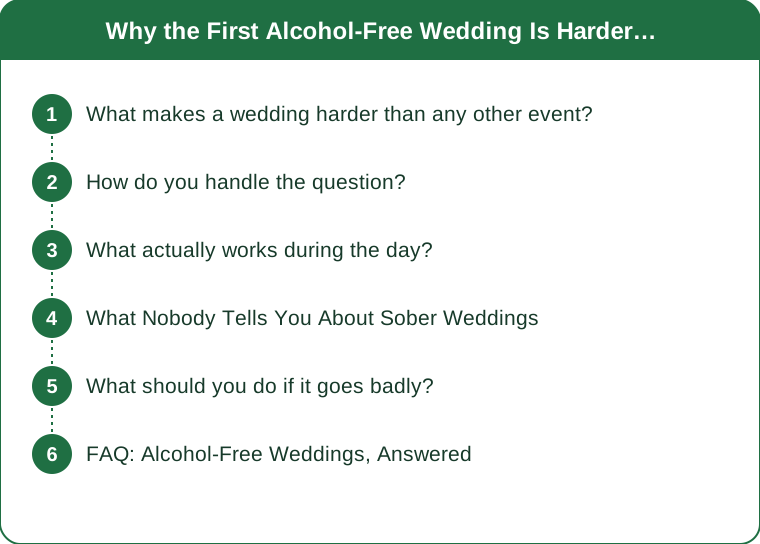
What makes a wedding harder than any other event?
Duration is the first and most underrated factor.
A dinner is three hours. A wedding runs from a morning arrival to a late-night departure — often twelve or more, with long unstructured gaps between ceremony, photographs, meal and dancing. Those gaps are the difficulty. Every one of them is a stretch of standing around where drinking is the default activity, and where you have nothing to do with your hands, your attention, or your body.
The second is that drink is free and continuously offered. Nobody has to decide to buy another; it simply appears. Declining is not a single decision but a repeated one, perhaps fifteen or twenty times across the day.
The third is ritual. Toasts are formalised drinking, performed publicly, with attention on everyone at once. Standing with something visibly different in your glass while a room raises theirs is a specific kind of exposure that ordinary socialising does not produce.
The fourth is the audience. Weddings gather people from every era of your life, many of whom last saw you at a point when you drank. Each of them may ask, and each conversation restarts from zero.
How do you handle the question?
Decide your answer before you arrive, and make it short.
The reason the question is difficult is not the question. It is being asked it unprepared, sixteen times, while tired, and improvising a new response each time. Preparation removes almost all of the difficulty.
Pick one line and use it every time. Options that work, roughly from least to most disclosure:
- ‘Driving later.’ Ends the conversation instantly. Requires no explanation.
- ‘Taking a break from it.’ Vague, true, and rarely followed up.
- ‘I feel better without it.’ Honest, positive, hard to argue with.
- ‘I don’t drink.’ The most direct, and worth having available for anyone who persists.
The short answer works better than the honest long one at a wedding specifically, because you are having twenty conversations rather than one, and a full explanation twenty times is exhausting in a way that has nothing to do with how you feel about it.
One thing worth knowing: most people ask once and move on. The imagined interrogation is far worse than the actual response, which is usually a nod and a change of subject. The persistent pusher exists, but there is typically one of them at a wedding, not twenty.
What actually works during the day?
Structural tactics beat willpower every time, because willpower degrades over twelve hours and structure does not.
Always have a full glass. This is the single most effective tactic available. A hand holding a drink is not offered another one. Get something at the bar the moment you arrive and never let it empty — top it up before it does, not after.
Choose something that looks like a drink. Sparkling water with lime in a wine glass, a proper alcohol-free beer in the bottle, a soda and bitters. Not because you owe anyone a disguise, but because a visibly different drink invites comment, and fewer comments means a better day.
Know your exit time before you arrive. Decide in advance — ‘I’m leaving at 11’ — and arrange the transport to enforce it. Open-ended attendance is where difficulty accumulates, because the hardest hours are the last ones.
Book your own transport. Not a lift with someone else. Autonomy over when you leave is worth the cost.
Have a job. Photographs, checking on an elderly relative, helping with something. Purpose fills the unstructured gaps that would otherwise be filled by drinking.
Eat properly. Wedding meals are late and often small. Arriving hungry and staying hungry makes everything harder, and low blood sugar is frequently mistaken for craving.

What Nobody Tells You About Sober Weddings
The ceremony is the easy part. People brace for the whole day and the first two hours are entirely fine. The difficulty starts in the gap between the ceremony and the meal, when everyone else has been drinking for an hour and you have not.
Around 9pm, the conversation stops being interesting. This is the observation nobody prepares you for and it is jarring the first time. Sober, you notice that the room has become repetitive, louder, and less coherent, and the sense of being on a different wavelength arrives quite suddenly. It is not judgement — it is just a real perceptual difference that everyone experiences and nobody mentions.
Dancing is genuinely harder sober, and also completely possible. Most people report that the first ten minutes are excruciating and then it stops mattering. Waiting until the floor is busy helps a great deal.
You will remember all of it. Including the speeches, the conversations, and how the couple actually looked. People consistently describe this as the compensation that made it worth it, and it is not a consolation prize.
The next morning is a different species. Being the only person at breakfast who is functional is a strange and reliably pleasant experience, and for many people it is the thing that makes the second wedding much easier than the first.
Nobody is watching you as closely as you think. Weddings are self-absorbed events. The attention you imagine on your glass is almost entirely internal.
Leaving early is completely normal. People leave weddings at all hours and nobody tracks it. The imagined scrutiny of an early exit does not exist.
What should you do if it goes badly?
Plan for a difficult moment rather than assuming there will not be one.
Have somewhere to go. A walk outside, the car, a quiet corridor. Ten minutes away from the noise resets a great deal, and the option existing is often enough that you do not need it.
Have someone to message. Text a friend who knows. The gap between feeling isolated in a room of drinkers and feeling connected to someone who understands is one message wide.
Leave if you need to. This is permitted. The cost of leaving a wedding two hours early is essentially zero. The cost of staying somewhere you should not be is not.
If it does go wrong, it is a data point rather than a verdict. People who drink at one difficult event and continue on their path afterwards vastly outnumber those for whom it becomes a turning point. Treating a single evening as proof of anything is more damaging than the evening itself.
And afterwards, notice what actually happened. Most first sober weddings are reported as significantly better than anticipated. The anticipatory dread is usually the hardest part of the whole experience, which is worth knowing before the second one.
If you are cutting down or stopping after a long period of heavy drinking, do not plan that around an event — and be aware that stopping abruptly after sustained heavy use can be medically risky. That is a conversation for a GP, not a wedding. This is general information, not medical advice.
FAQ: Alcohol-Free Weddings, Answered
Should I tell the couple in advance?
A quick message beforehand is usually worth it — not for permission, but so there is an alcohol-free option at the table and nobody is caught out during the toast. Most couples appreciate knowing and it removes several small awkward moments from the day.
What do I do during the toast?
Raise whatever is in your glass, exactly like everyone else. Toasting is about the gesture rather than the contents, and nobody inspects glasses. This is one of the most anticipated difficulties and one of the least actual ones.
How do I handle someone who keeps pushing?
Repeat the same short line without elaborating or justifying. Persistent pushing usually feeds on engagement, and a flat, friendly, unchanged response ends it faster than any explanation. If it continues, physically move — go to the bar, join another conversation. You are not obliged to complete that exchange.
TL;DR:
- Weddings stack four hard elements at once: twelve-hour duration, free drink, public toasting, and an audience from every era of your life.
- Decide one short answer to the question in advance and reuse it — improvising twenty times is what exhausts people.
- Keep a full glass at all times, choose something that looks like a drink, and know your exit time before you arrive.
- The gaps between the scheduled parts are the difficult bit, not the ceremony or the meal.
- Around 9pm the room changes and you will notice it — that is normal, not a sign anything is wrong.
The first one is the hardest by a considerable margin, and almost everyone reports the second as unremarkable. What gets you through it is not resolve on the day but decisions made before you arrive — the answer, the drink, the transport, and the time you are leaving.
Keep Reading
This article is for general informational purposes only and is not medical advice. Always consult a qualified health professional for guidance specific to you.