Why Social Events Get Harder Around Month Two Alcohol Free
Quick Answer: Month two is harder because the things carrying you through month one — novelty, visible progress, attention from others — all fade at once, while the social situations keep coming. It is a predictable dip, not a sign of failure. What works is arriving with a drink already in hand, a planned exit time, a one-sentence answer you are not defending, and accepting that a stretch of events will feel flat before your baseline resets.
Week two was easy. You felt great and everyone noticed.
Week seven, at a party, you are counting the minutes.
This dip is on the map. It arrives for almost everyone.

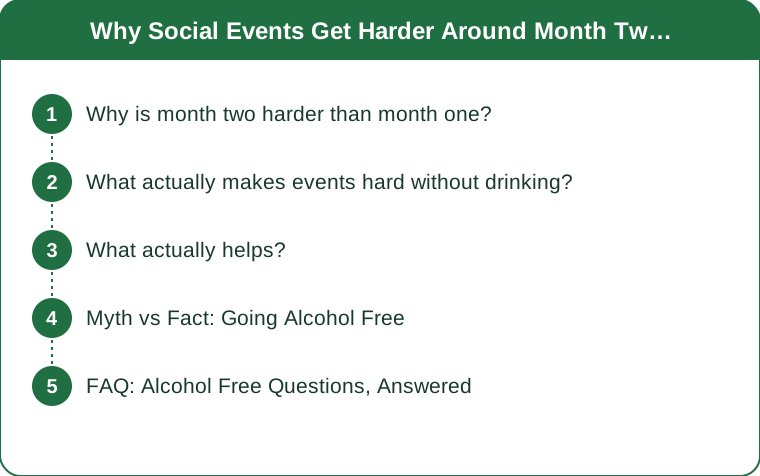
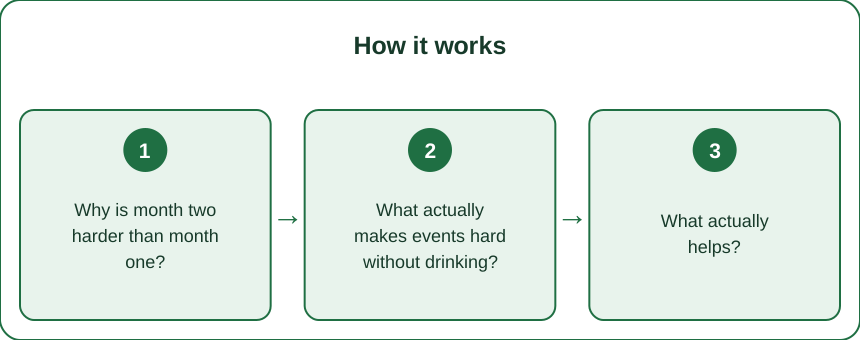
Why is month two harder than month one?
Because everything that made month one work has a short shelf life.
Novelty carried you and it has run out. New behaviours get a genuine boost from being new. Around six to eight weeks that fades and the behaviour has to stand on its own.
The obvious wins have already landed. Better sleep, clearer mornings, less anxiety — most of that arrives in the first month. Month two delivers fewer new improvements, so the reward signal weakens even though the benefits are still there.
People stopped noticing. The early attention and encouragement were real motivators. By week seven nobody comments, and the external support quietly disappears.
Your social calendar caught up with you. Early on, people often avoid a few events. By month two you are attending everything again, which means facing the situations you initially sidestepped.
The reasons that started it have faded. The rough night or the bad morning that prompted this is now two months away and much less vivid.
And the social discomfort is genuinely real. Alcohol lowers social anxiety in the moment. Without it, events can feel effortful in a way they did not before — and that skill takes months to rebuild, not weeks.
What actually makes events hard without drinking?
Six specific things, worth naming individually because each has its own fix.
The empty hands problem. Standing with nothing to hold is genuinely uncomfortable and makes you feel conspicuous. Solved entirely by holding a drink of any kind.
The question. Being asked why you are not drinking, repeatedly, by people who mean nothing by it. It is tiring more than it is offensive.
The energy mismatch. Around the second hour, everyone else moves into a looser, louder register and you do not. Conversation quality often drops sharply at that point.
Missing the transition ritual. The first drink used to mark the shift from work-mode to social-mode. Losing that means arriving at events still in your working headspace.
Social anxiety with nothing dampening it. For anyone who used alcohol to smooth this, the underlying discomfort is simply there again, and it takes time and repetition to build tolerance for it.
Discovering some events were only about drinking. This is the uncomfortable one. Certain gatherings turn out to have very little else in them, and that realisation is a loss even when it is useful information.

What actually helps?
Six practical strategies, most of which are logistics rather than willpower.
Arrive with a drink already in your hand. Get something at the bar immediately or bring your own. This removes the empty-hands problem and roughly 80% of the questions before they are asked.
Have a one-sentence answer and do not elaborate. Not drinking tonight, or I’m driving, or I’m off it at the moment. Said lightly and followed by a question back. Explanations invite discussion; a short answer closes it.
Decide your exit time before you go. Knowing you are leaving at 10 makes the whole evening easier, and lets you enjoy the good part rather than enduring the tail. Leaving at the point when the energy shifts is not antisocial; it is well-timed.
Build a replacement transition ritual. A walk before the event, changing clothes deliberately, ten minutes of something that marks the shift. The first drink was doing a job, and the job still needs doing.
Choose the seat and the timing. Arrive early when conversation is better, sit rather than stand, and talk to one or two people properly rather than working the room.
Eat properly beforehand. Low blood sugar at a loud event is miserable and easily mistaken for wanting a drink.
This is general information, not medical advice. Anyone with physical dependence should not stop drinking without medical supervision — withdrawal can be dangerous.
Myth vs Fact: Going Alcohol Free
Myth: it gets steadily easier. Fact: it improves in waves with predictable dips. Week three and around month two are the two most commonly reported ones. Expecting the dip makes it far easier to pass through.
Myth: you will lose your friends. Fact: most people barely notice after the first few occasions. What often changes is which events you want to attend, more than which people you see.
Myth: you have to explain yourself. Fact: a short answer is a complete answer. People take their cue from your tone — if you are relaxed about it, they are.
Myth: non-alcoholic drinks are a crutch to avoid. Fact: for most people they help enormously. Having something in your hand that feels like an occasion solves several problems at once.
Myth: the benefits are all in the first month. Fact: sleep quality, resting heart rate and mood stability continue improving well past month one. The changes just become less dramatic and harder to notice from inside.
Myth: if a social event feels flat, it is a sign this is not for you. Fact: it is a sign your baseline is recalibrating. Events genuinely feel different for a few months before they settle, and this is the single most common reason people conclude it is not working.
FAQ: Alcohol Free Questions, Answered
Does the social awkwardness go away?
Largely, over a few months. Repetition builds the skill of being at events without a drink, and it does get easier — just not on the timeline most people expect.
What should I say when asked?
One short sentence, lightly, then change the subject. Not tonight works for almost every situation.
Are non-alcoholic beers and spirits a good idea?
For most people, yes. Some find the taste triggering — that is individual, and worth testing rather than deciding in advance.
Why do I feel more anxious at events now?
Alcohol was dampening social anxiety in the moment. Without it, the underlying level is simply visible again. It settles as you build repetitions.
Is month two a normal dip?
Very. Novelty, visible progress and other people’s attention all fade around the same time, while events keep coming.
Should I avoid drinking events entirely at first?
A few, early on, is sensible. Avoiding all of them long-term prevents you building the skill you need.
When should I get professional support?
If you experience physical withdrawal symptoms, if stopping feels impossible, or if drinking is affecting your health, work or relationships. Withdrawal can be medically dangerous — speak to a doctor rather than going it alone.
TL;DR:
- Month two is a known dip — novelty, visible progress and other people’s attention all fade at once.
- Events are hard for specific, fixable reasons: empty hands, the question, the energy shift, the missing transition ritual.
- Arrive with a drink in hand and it solves most of it before anyone asks.
- Have a one-sentence answer and a planned exit time.
- Events feeling flat means your baseline is recalibrating, not that this is not for you.
For the next event, decide your leaving time before you go and get a drink in your hand within a minute of arriving. Those two things carry most of the evening.
This is general information, not medical advice. If you experience physical withdrawal symptoms, speak to a doctor before stopping.
Keep Reading
This article is for general informational purposes only and is not medical advice. Always consult a qualified health professional for guidance specific to you.