Why Your Sleep Gets Worse Before It Gets Better When You Stop Drinking
Quick Answer: Alcohol suppresses REM sleep, so when you stop, REM comes back all at once - a rebound that brings vivid dreams and more frequent waking. At the same time your body has adapted to alcohol as a sedative and needs time to recalibrate its own sleep signals. The result is genuinely worse sleep for roughly the first week or two, followed by a clear improvement. Expect a rough patch, plan for it, and judge the experiment at week four, not week one.
The bad sleep is not a sign it is not working.
It is the most reliable sign that it is.
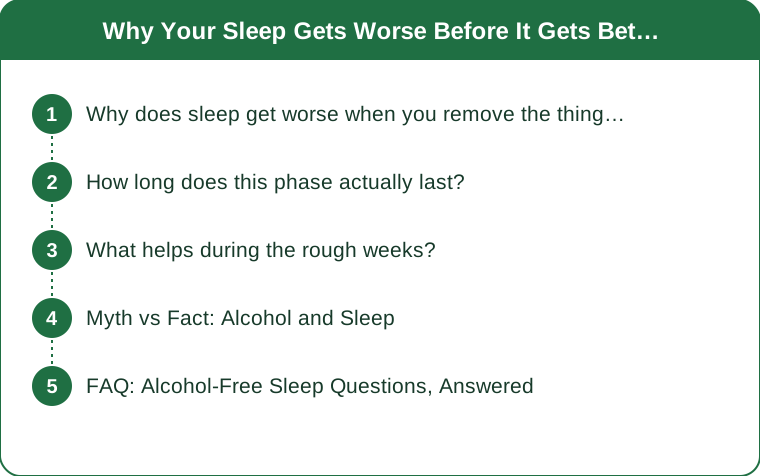
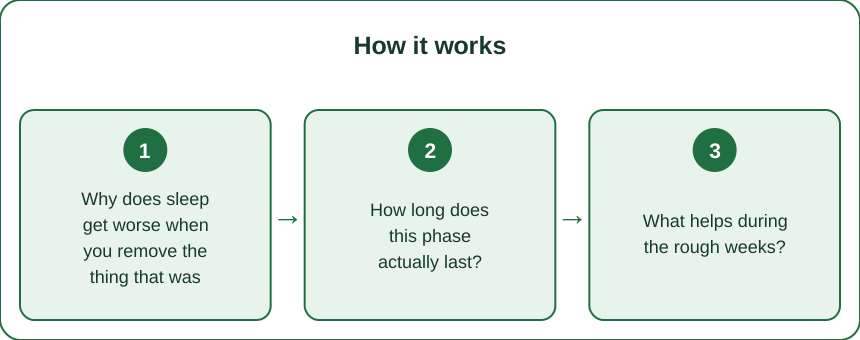
Why does sleep get worse when you remove the thing that was ruining it?
Because your sleep architecture adapted to alcohol’s presence, and removing it exposes the adaptation.
Alcohol is a sedative, not a sleep aid. It shortens the time it takes to fall asleep, which is why it feels helpful, but it fragments the second half of the night as it is metabolised. Falling asleep faster and sleeping worse are entirely compatible.
It suppresses REM sleep, especially early in the night. REM is the stage associated with vivid dreaming and with emotional processing and memory consolidation. Regular drinking means a chronic REM deficit that builds quietly over months.
When alcohol stops, REM returns forcefully. This rebound produces unusually vivid, intense, sometimes unsettling dreams, and REM sleep is lighter than deep sleep - so you wake more easily during it. The vivid dreams and the frequent waking are the same phenomenon.
Your body also loses its sedation cue. If falling asleep has been chemically assisted for a long time, the natural wind-down process is out of practice and takes time to reassert itself.
And a stimulated nervous system takes days to settle. In the early period after regular drinking stops, many people feel restless and alert at exactly the wrong time of day.
The important framing: this is a recalibration, not a relapse into worse sleep. The system is coming back online after being suppressed.
How long does this phase actually last?
Shorter than it feels, and the pattern is fairly consistent across people.
The first few nights are usually the hardest. Difficulty falling asleep, waking in the early hours, and vivid dreams are all most intense at the start.
Weeks one and two are the messy middle. Sleep is fragmented and dreams are intense, but total sleep time typically starts recovering. Many people report feeling more tired in this window than they did while drinking, which is exactly when most give up.
By week three or four, most people notice the turn. Deeper sleep, fewer wakings, and - the detail almost everyone mentions - waking before the alarm without the dread.
The improvement continues past the point people stop tracking it. Sleep quality generally keeps improving over months, not weeks, which is why the four-week judgement point is the right one.
Individual variation is large. Duration and volume of previous drinking, sleep conditions, stress, and other factors all shift the timeline substantially.
Judge the experiment at four weeks. Quitting at day five and concluding that alcohol was helping your sleep is judging the withdrawal, not the outcome.
And if the insomnia is severe, or you experience shaking, sweating, confusion, or a racing heart when you stop drinking, seek medical advice immediately - heavy alcohol withdrawal can be genuinely dangerous and should be managed with a doctor. This is general information, not medical advice.

What helps during the rough weeks?
Structure, temperature, and lowered expectations - in roughly that order.
Keep the wake time fixed, even after a bad night. A consistent wake time is the strongest anchor for the whole system. Sleeping in to compensate delays the reset by days.
Replace the wind-down ritual, not just the drink. A large part of the evening drink was a signal that the day had ended. Something has to occupy that role - tea, a shower, a book, a walk. An absence is much harder to sustain than a substitution.
Get morning light within an hour of waking. Bright light early is the strongest single input to your circadian timing, and it matters most exactly when that timing has been disrupted.
Keep the room cool. Alcohol withdrawal often comes with feeling warm and sweaty at night, and a cooler room helps more than usual during this period.
Expect to be awake sometimes, and plan for it. Lying in the dark trying to force sleep raises arousal. Get up, keep the lights low, read something dull, and return when sleepy - fighting it extends it.
Watch the caffeine that crept in. Tiredness during week one often leads to more coffee later in the day, which then worsens the sleep, which leads to more coffee. Cut off caffeine by early afternoon during this phase specifically.
And be careful about the sugar swap. Many people replace alcohol with sweet drinks or desserts in the evening, which is understandable but does not help the sleep half of the equation.
Myth vs Fact: Alcohol and Sleep
Myth: A nightcap helps you sleep. Fact: it helps you fall asleep and then damages the rest of the night. Sleep onset speed and sleep quality are separate things, and alcohol trades the second for the first.
Myth: One or two drinks is too little to affect sleep. Fact: even moderate amounts measurably reduce REM and increase second-half fragmentation. The effect is smaller, not absent, and the 3am waking after a couple of glasses is a very common experience.
Myth: The vivid dreams mean something is wrong. Fact: they are REM rebound and they indicate the suppression is lifting. Unsettling, but a good sign.
Myth: If sleep is worse without alcohol, alcohol was helping. Fact: you are measuring the withdrawal period, not the steady state. The comparison only becomes meaningful after several weeks.
Myth: Drinking earlier in the evening avoids the problem. Fact: it genuinely helps - finishing several hours before bed means more of it is metabolised before you sleep - but it reduces the effect rather than removing it.
Myth: You can catch up on the lost sleep at the weekend. Fact: irregular timing is its own problem, and it works against exactly the circadian consistency that helps the most during this phase.
FAQ: Alcohol-Free Sleep Questions, Answered
Why am I waking at 3am specifically?
As alcohol clears, its sedative effect ends and there is often a rebound in alertness - which tends to land in the early hours. During the alcohol-free adjustment, the same time slot is when REM rebound is most active, so the waking continues for a while even without the drink.
Should I take something to help me sleep through it?
Talk to a pharmacist or doctor rather than self-medicating, particularly with anything sedating. Behavioural approaches - fixed wake time, morning light, cool room, and a replacement wind-down - address the actual mechanism and do not create a new dependency.
Is it normal to feel more tired for the first two weeks?
Yes, and it is the most common reason people conclude the experiment failed. Daytime tiredness in weeks one and two is expected; if it is still there at week six, that is a different question worth raising with a doctor.
TL;DR:
- Alcohol suppresses REM, so stopping causes a REM rebound - vivid dreams and lighter, more interrupted sleep.
- The first two weeks are genuinely worse. That is the adaptation lifting, not evidence alcohol was helping.
- Most people notice the turn around week three or four. Judge the experiment then, not on day five.
- Fixed wake time, morning light, a cool room, and a replacement wind-down ritual do the most work.
- Severe insomnia, shaking, sweating, or confusion on stopping needs medical attention, not patience.
Mark week four on a calendar before you start. Having the judgement date decided in advance is what gets most people through week one.
Keep Reading
This article is for general informational purposes only and is not medical advice. Always consult a qualified health professional for guidance specific to you.