Why Cutting Back on Alcohol Doesn't Feel Relaxing Yet (and When It Will)
Quick Answer: Early alcohol reduction often feels more restless, not calmer, because alcohol was masking baseline anxiety rather than resolving it — most people report a genuine shift toward calm somewhere between week 3 and week 6, not immediately.
You cut back expecting to feel lighter right away. Instead, evenings feel fidgety, sleep is choppier, and the relaxation you were promised is nowhere in sight yet. That gap is common, and temporary.

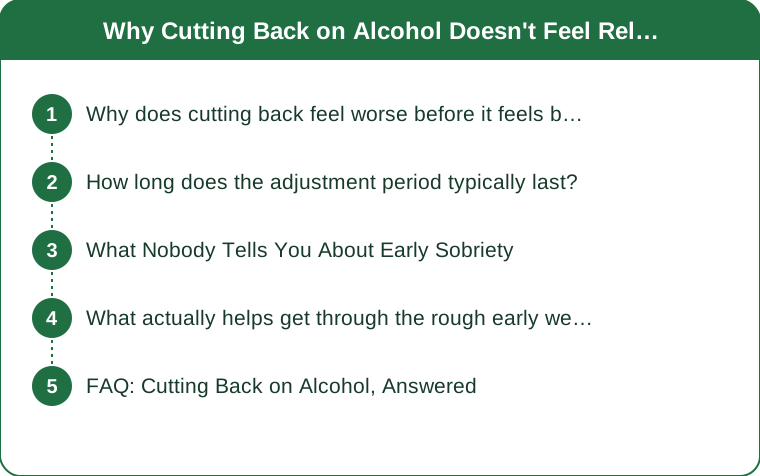
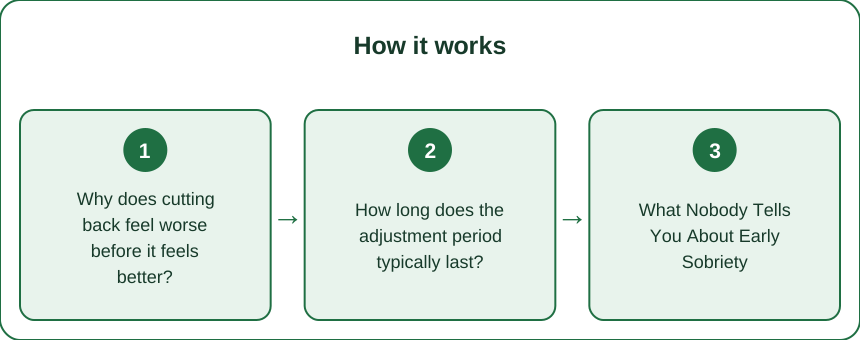
Why does cutting back feel worse before it feels better?
Alcohol suppresses the nervous system in the moment, but the rebound effect afterward — sometimes called ‘wired but tired’ — leaves you more activated than baseline for a period after quitting or cutting back, not less.
This is your body recalibrating a system that got used to regular suppression, not a sign that reducing alcohol was the wrong call.
How long does the adjustment period typically last?
Most people report a noticeable shift toward calmer evenings and better sleep somewhere in the 3-6 week range, with the first 1-2 weeks often being the roughest for restlessness and sleep quality specifically.
This varies by how much and how long someone was drinking before cutting back — a longer, heavier pattern generally means a longer adjustment window.

What Nobody Tells You About Early Sobriety
The most disorienting part often isn’t cravings — it’s not knowing what to do with your hands or your evening when a habitual ritual (the pour, the first sip) is suddenly missing from the routine.
A less discussed effect: social events can feel more effortful at first, since alcohol was doing some of the social-ease work. That effortfulness fades as new patterns form, but it’s real in the first few weeks and worth planning around rather than being surprised by.
What actually helps get through the rough early weeks?
A replacement ritual at the same time and in the same glass (sparkling water with bitters, a non-alcoholic beer, herbal tea) preserves the routine cue without the substance, which meaningfully reduces the ‘something’s missing’ feeling in the evening.
Tracking sleep and mood daily (even a 1-10 note) helps you notice the gradual improvement that’s easy to miss day-to-day — many people underestimate their own progress without a written record.
FAQ: Cutting Back on Alcohol, Answered
Is it normal to feel more anxious in the first two weeks?
Yes, this is a commonly reported pattern and generally temporary — if anxiety is severe or accompanied by physical symptoms like tremors, that’s a signal to talk to a doctor, especially with heavier prior drinking.
Why is sleep worse right after cutting back, not better?
Alcohol disrupts REM sleep even though it can help you fall asleep faster — early on, your sleep architecture is recalibrating, which can feel like worse sleep before it improves.
Does non-alcoholic beer or wine help or just prolong the habit?
For most people it helps by preserving ritual without the substance — if it triggers cravings for the real thing, that’s a signal to try a different replacement instead.
TL;DR:
- Early restlessness after cutting back is a rebound effect, not proof it’s not working
- Most people report real improvement in the 3-6 week range, not immediately
- The habitual ritual gap (not cravings) is often the hardest part of the first weeks
- A same-time, same-glass replacement ritual meaningfully eases the transition
If you’re in week one or two and it feels harder, not easier — that’s expected. This is general information, not medical advice.
Keep Reading
This article is for general informational purposes only and is not medical advice. Always consult a qualified health professional for guidance specific to you.