Why Drinking Less Is Harder at Home Than at a Bar
Quick Answer: A bar has friction, cost, an end time, and social witnesses. Home has none of those, plus a much denser set of cues — the same chair, the same hour, the same programme, the same glass — that trigger the behaviour automatically. Cutting back at home is a cue and friction problem rather than a willpower one, and the interventions that work are physical: move the location, change the vessel, add steps between you and the bottle, and replace the ritual rather than removing it.
This is why people report the sober month going well until the second week at home.
This blog has covered why week three alcohol-free is harder than week one, why you crave alcohol at a specific time, and why declining a drink feels harder in a group. Home is a different failure mode from all of them.

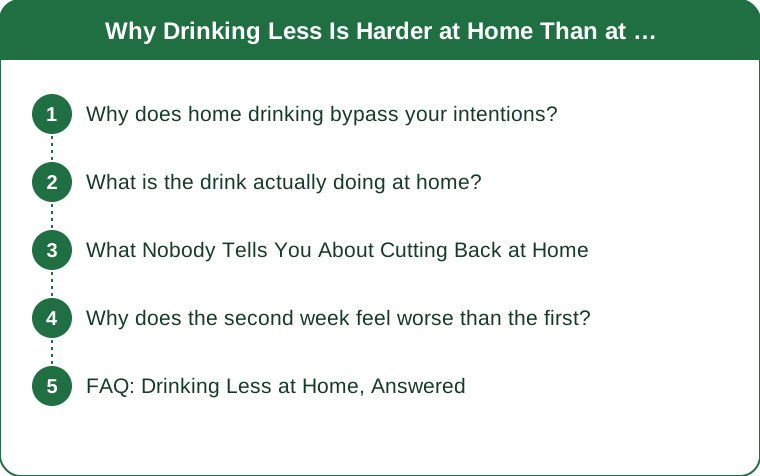
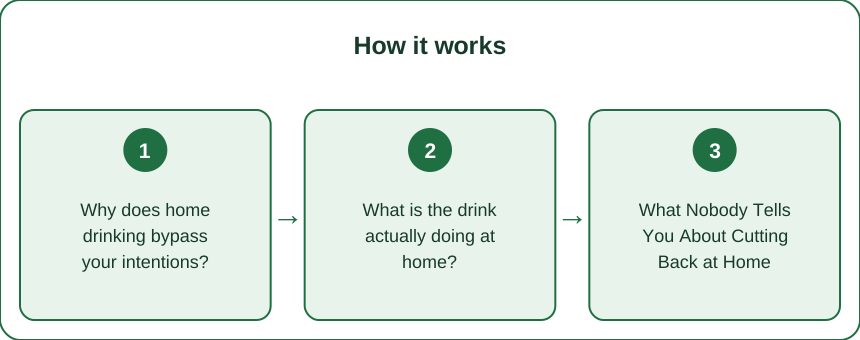
Why does home drinking bypass your intentions?
Because it runs on cues rather than decisions, and cues do not consult you.
Habits are triggered by context, and home is the single most cue-dense environment you occupy: the same room, chair, time, lighting, sounds, and often the same programme night after night.
The cue-to-action loop can complete before deliberate thought engages. People report pouring a drink and only then noticing they had decided not to, which is a genuine feature of how habits work rather than an excuse.
There is essentially no friction. At a bar there are steps: get up, queue, order, pay, wait. At home the bottle is nine seconds away.
Cost has no signal at home. The bottle was already paid for last Saturday, so nothing about pouring registers as an expenditure.
There is no end point. A bar closes, the group leaves, the last train goes. A sofa on a Tuesday has no boundary at all.
And nobody sees. The social witness that makes people moderate in public is entirely absent, and for most people that turns out to be a much larger factor than they would like.
What is the drink actually doing at home?
Usually marking a transition, which is why removing it leaves a gap that white-knuckling cannot fill.
The most common function is signalling the end of the working day. The pour is a boundary marker between obligations and rest, and with remote work that boundary is otherwise nonexistent.
The second is a decompression ritual — something in the hands, a change in sensation, a signal to the body to stand down.
The third is filling a specific empty half hour, usually between finishing tasks and starting the evening properly.
Note that none of those are about the alcohol. They are about ritual, transition, and sensation, and that is genuinely good news because those are replaceable.
Which is why simply removing the drink fails. The cue still fires, the need is still there, and there is nothing occupying the slot.
And it is why the replacement has to be a full ritual, not just a different liquid. A glass of tap water does not mark a transition. A specific drink, in a specific glass, made in a specific way, at a specific time, does.

What Nobody Tells You About Cutting Back at Home
The effective interventions are almost entirely environmental, and they feel embarrassingly simple.
Change where you sit for the first two weeks. The chair is a cue. Sitting somewhere else genuinely weakens the trigger, and this costs nothing.
Add physical friction. Do not keep it in the kitchen. A different floor, a high cupboard, or simply not in the house at all converts a nine-second action into a decision, and decisions are winnable in a way that reflexes are not.
Change the vessel deliberately. The wine glass is a strong cue in itself. A different glass for your replacement drink is one of the highest-return changes available.
Make the replacement genuinely elaborate. Ice, a good glass, something bitter or aromatic, a garnish, a slow build. The ritual is what you are replacing; a can of something in the hand does not do the job.
Move the transition out of the room entirely. A ten-minute walk at the end of the working day marks the boundary better than any drink does and removes you from the cue environment at exactly the moment it fires.
Bitter and complex flavours work better than sweet ones. Sweet soft drinks leave people wanting; tonic, bitters, alcohol-free aperitivi, strong tea and sparkling water with something sharp satisfy far more of the sensory expectation.
And plan for the specific hour. Almost everyone has one — 6.15, or the moment the laptop closes. Knowing yours and having something scheduled in it does more than any general resolution.
Why does the second week feel worse than the first?
Because novelty is doing the work in week one and structure has to do it after that.
Week one has momentum, attention and a fresh decision behind it. All three fade on roughly the same timeline.
Sleep frequently gets worse before it gets better. Alcohol suppresses REM sleep, and the rebound in the first one to two weeks can produce vivid dreams and lighter, more broken sleep, which is genuinely unpleasant and easy to misread as the change not working.
The evening now has a real, felt gap in it where the ritual was, and boredom is a stronger driver than craving for most people.
Nobody is congratulating you any more. The social reinforcement of announcing a change is entirely front-loaded.
And the first genuinely bad day arrives. Week one rarely contains one; week two or three usually does, and that is the actual test.
Which means the structures need to be built in week one while it is easy. Anyone relying on how good week one felt is unprotected by the time they need it.
Sleep does improve. Most people see it settle and then improve beyond baseline somewhere in weeks two to four, which is worth knowing while it is still bad.
FAQ: Drinking Less at Home, Answered
Why is it easier to skip drinks out than at home?
Bars have friction, cost, an end time and social witnesses. Home has none of those and far denser habit cues — same chair, same hour, same glass. It is an environment problem, not a willpower difference.
What should I drink instead in the evening?
Something bitter or complex rather than sweet, in a different glass from your usual one, made with some ritual — ice, garnish, a slow pour. Tonic with bitters, alcohol-free aperitivi, or strong cold tea satisfy far more of what the drink was actually doing than a sweet soft drink does.
Why is my sleep worse since I stopped drinking?
Alcohol suppresses REM sleep, and there is commonly a rebound period of vivid dreams and lighter sleep in the first one to two weeks. It typically settles and then improves past your previous baseline within a month.
This is general information, not medical advice. If you experience physical withdrawal symptoms such as shaking, sweating or confusion when you stop drinking, speak to a doctor before continuing.
TL;DR:
- Home drinking runs on cues and near-zero friction, not on decisions, which is why intentions lose to a familiar chair at a familiar hour.
- The drink is usually marking a transition. Remove it without replacing the ritual and the slot stays empty.
- The effective moves are physical: change the seat, change the glass, move the bottle out of easy reach, and walk at the boundary hour.
- Week two is harder than week one because novelty fades and sleep temporarily worsens. Both are expected and both pass.
Build the structures in week one while it still feels easy. That is the week that decides how week three goes.
Keep Reading
This article is for general informational purposes only and is not medical advice. Always consult a qualified health professional for guidance specific to you.