What Actually Changes in Your Evenings After Ninety Days Alcohol Free
Quick Answer: By day 90, the physical changes have mostly settled - sleep architecture has normalised, energy has stabilised, and the early skin and digestion changes have plateaued. What is still actively changing is structural: you have roughly two to four hours of genuinely different evening time, your social calendar has reorganised itself around who did and did not adapt, and your sense of what an evening is for has shifted. The third month is the one where the habit stops being an effort and starts being a schedule.
Here is what people consistently report, and what to expect next.

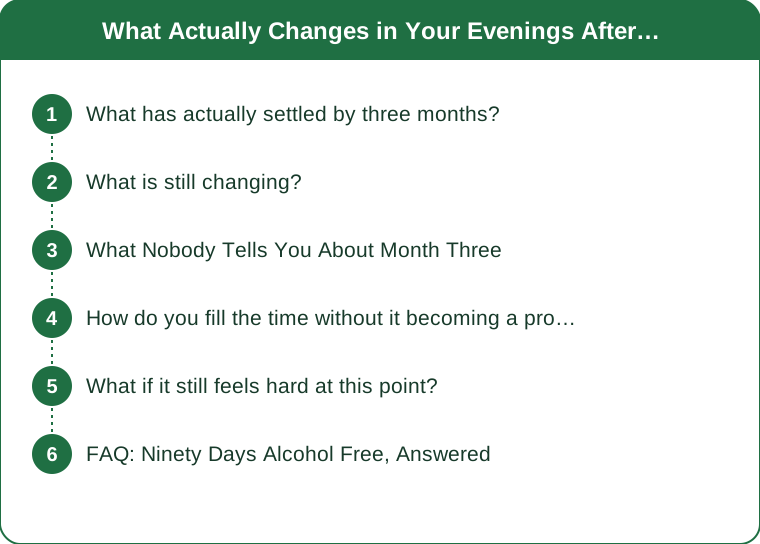
What has actually settled by three months?
Sleep is the most consistently reported change and it has usually stabilised by now. Alcohol suppresses REM sleep in the first half of the night and fragments the second half. Without it, sleep architecture normalises within a few weeks - and by month three, most people have stopped noticing it, which is itself the point.
The paradoxical early phase is over. Many people sleep worse for the first one to three weeks, which is why so many give up in that window. By 90 days that has long passed.
Energy has flattened out rather than surged. The early dramatic energy reports usually settle into something steadier and less remarkable. The absence of low days is more noticeable than any high, which is a harder thing to feel grateful for.
Skin changes have plateaued. The early improvements - less puffiness, better hydration, less redness - happen mostly in the first six to eight weeks. What you have at 90 days is roughly what you will have, absent other changes.
And appetite and weight have usually found a new normal. Some people lose weight, some gain from replacing alcohol with sugar, and a few change nothing at all. All three are common and none indicate anything is going wrong.
What is still changing?
Time is the big one, and it is the least discussed. Drinking evenings compress: you drink, you get tired, the evening ends. Sober evenings are longer - genuinely two to four hours of usable time - and by month three, the novelty has worn off and the question of what to do with them becomes real.
This is where people report a slump that nobody warned them about. The health improvements have plateaued, the novelty is gone, and the evenings are long. It is not a craving problem, it is an occupation problem, and it responds to filling the time rather than to willpower.
Social patterns have sorted themselves out by now. Some friendships adapted, some quietly did not, and by month three you know which is which. People consistently describe this as the hardest genuine loss, and it is more significant than any physical symptom.
Your relationship to events has changed rather than your ability to attend them. Most people at 90 days can go to a party comfortably. What has changed is wanting to leave at 10pm, which is a preference shift rather than a discipline one.
And identity is the slowest-moving part. Around three months, many people stop describing themselves as not drinking and start simply being someone who does not. That transition is gradual, it is not marked by anything, and it is the change that predicts whether it lasts.
What Nobody Tells You About Month Three
The compliments stop, and that matters more than it should. The first month attracts attention and encouragement. By month three nobody mentions it, and the external reinforcement that helped early on has quietly gone.
Boredom is the most common relapse trigger at this stage, not craving. The urge is rarely for alcohol specifically - it is for the evening to be different. Recognising that distinction is genuinely useful, because the solutions are different.
You will have found out what alcohol was doing for you. For most people it was transition - marking the end of the working day. Without a replacement ritual, the day just runs on, and this is why so many people at three months report that evenings feel undifferentiated rather than tempting.
Money adds up visibly by now. Ninety days at even moderate drinking is a substantial sum, and seeing it as a single number is more motivating than the daily saving ever was. Adding it up is worth doing deliberately.
The autumn timing is worth naming specifically. Summer socialising is outdoor, daytime, and easy to do without a drink. As it moves indoors and into the evening, the situations get harder, and people who started in June often find September the first real test.
And the first big occasion after 90 days carries disproportionate weight. A wedding, a work party, a holiday. Planning that one specifically - what you will drink, when you will leave, who knows - matters more than general resolve.

How do you fill the time without it becoming a project?
Replace the ritual, not the hours. The 6pm marker mattered more than the alcohol did for most people. A specific drink, made deliberately, at the same time, does most of that work - and that is why alcohol-free beer and elaborate soft drinks are more useful than they look.
Pick one thing that needs a block of time. Reading, an instrument, a craft, a long walk. The specific activity matters less than it filling a recognisable evening-shaped hole.
Beware turning it into optimisation. Some people fill the time with productivity and burn out. Evenings are allowed to be unproductive - the goal is not to convert drinking hours into achievement hours.
Keep at least one social thing in the evening slot. Isolation is a real risk at three months, particularly if some friendships changed. A weekly fixture with someone matters more than any solo habit.
Go to bed at a normal time. Long evenings tempt people into staying up, which undoes the sleep benefit that was the main reward - and tired is when the whole thing gets harder.
And plan the next 90 days rather than drifting. People who set a second horizon - a specific event, a season, a year mark - are considerably more likely to still be at it in month six than those who treat 90 days as an arrival.
What if it still feels hard at this point?
Difficulty at 90 days is common and is not a sign of failure. The expectation that it becomes effortless by three months is widespread and not well supported by how people actually describe it.
Distinguish between craving and habit gap. Wanting a drink specifically is different from wanting the evening to have a shape. The second is much more common at this stage and it responds to structure rather than resistance.
Watch for substitution that is not helping. Sugar, nicotine, or online spending stepping into the same slot is common and worth noticing early rather than at month six.
If you are drinking again and feeling like you failed, that is a very ordinary pattern rather than an ending. Most people who change their drinking do it across several attempts, and treating an attempt as data is more useful than treating it as a verdict.
Peer support helps more than most people expect. Groups, online or in person, provide the external reinforcement that disappeared after month one. The fact that nobody is congratulating you anymore is a solvable problem.
And be clear about when this needs professional support. If you experienced any physical withdrawal when stopping - tremor, sweating, nausea, agitation, and particularly anything like a seizure - that is a medical matter and stopping unsupervised can be dangerous. Persistent low mood or anxiety that has not lifted by three months is also worth raising with a doctor. This is general information, not medical advice.
FAQ: Ninety Days Alcohol Free, Answered
Does it get easier after three months?
Usually, but not in a straight line. The physical adjustment is done; what remains is habit and social patterning, and those shift more slowly and less predictably.
Why do my evenings feel empty rather than tempting?
Because alcohol was probably functioning as a transition marker between the working day and the evening. Without a replacement ritual, the day just continues - which reads as flat rather than as craving.
Have I already had most of the health benefits by now?
Most of the visible short-term ones - sleep, skin, energy, digestion - have largely settled by around eight weeks. Longer-term benefits accumulate over years rather than months.
Is it normal to have lost some friendships?
Common, and consistently described as one of the harder parts. Some social relationships were built around the activity, and by month three it is usually clear which adapted.
Should I set another goal after 90 days?
It helps. People who set a second horizon - an event, a season, a year - are noticeably more likely to still be at it at six months than those who treat 90 days as the finish line.
What if I drink again?
It is an extremely common pattern, and most people who change their drinking do so across multiple attempts. Treating it as information about what triggered it is more useful than treating it as a failure.
When should I speak to a doctor?
If stopping caused any physical withdrawal symptoms - tremor, sweating, agitation, or anything like a seizure - that needs medical supervision. Persistent low mood or anxiety at three months is also worth raising.
TL;DR:
- The physical changes have mostly settled by 90 days - sleep, energy, skin, and digestion plateau around the six to eight week mark.
- What is still changing is structural: two to four hours of different evening time, a reorganised social calendar, and a slow identity shift.
- Boredom, not craving, is the month-three risk. The urge is usually for the evening to be different, not for alcohol specifically.
- The compliments stop around now, and the loss of external reinforcement is a real and solvable problem - peer support fills it.
- Replace the ritual, not the hours. A deliberate 6pm drink does most of the work that alcohol was doing as a transition marker.
- Set a second horizon. People who plan the next 90 days are far more likely to still be going at six months.
Autumn moves socialising indoors and into the evening - if you started in summer, expect September to be the first real test. Any physical withdrawal symptoms need medical supervision. This is general information, not medical advice.
Keep Reading
This article is for general informational purposes only and is not medical advice. Always consult a qualified health professional for guidance specific to you.