How Long Until You Actually Feel the Benefits of Not Drinking?
Quick Answer: Sleep quality improves within 3 to 7 days, though you may feel worse before better. Energy and morning clarity usually arrive in weeks 2 to 3. Skin, digestion, and resting heart rate shift around weeks 3 to 6. Mood stabilization is the slowest and least linear — often 6 to 12 weeks. The critical thing to know: week one frequently feels worse than drinking did, and week three is where most people quit for reasons that have nothing to do with the alcohol.
You stopped drinking expecting to feel amazing, and instead you feel tired, foggy, and mildly cheated.
This is the most common and least discussed part of cutting back. The benefits are real and well documented, but almost none of them show up on the schedule people expect — and the dip in the third section is the one that catches people out completely.

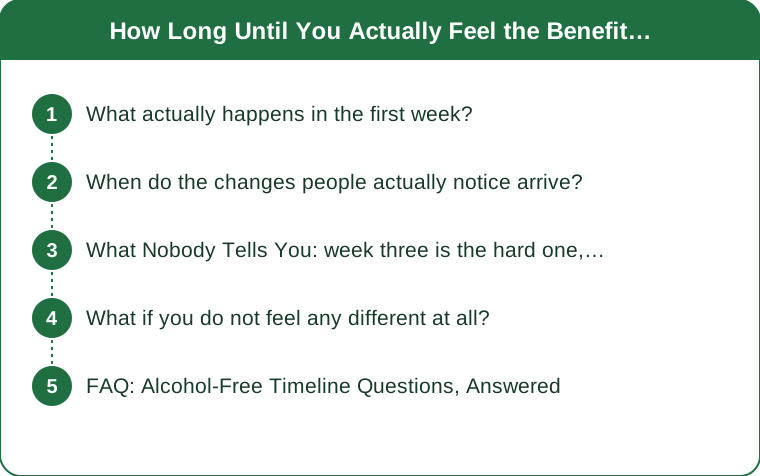
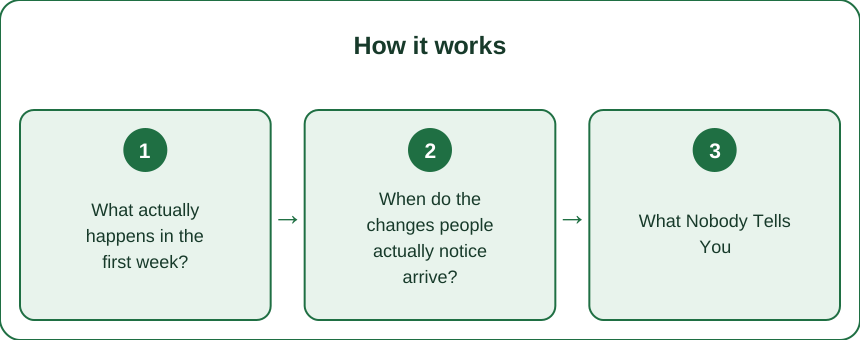
What actually happens in the first week?
Usually less than you hoped, and sometimes the opposite.
Sleep is the first thing to move, and it moves in two directions at once. Alcohol is a sedative — it shortens the time it takes to fall asleep — so removing it means the first few nights often involve lying awake longer than you are used to. At the same time, the second half of your night improves almost immediately: less fragmentation, more REM, fewer 3am wake-ups.
Net result: you may sleep less but rest better, and the subjective experience for the first three to five nights is often that sleep has got worse. It has not. Give it a week.
Hydration and digestion improve quickly. Alcohol suppresses the hormone that regulates fluid retention, so most people see reduced puffiness and less morning thirst within a few days.
Energy usually drops before it rises. This surprises people most. If you were drinking regularly, your body has been managing a daily chemical load, and the adjustment period includes fatigue that can last a week or more. It is normal and it passes.
If you have been drinking heavily or daily, stopping abruptly can carry real medical risk — including tremors, severe anxiety, and in serious cases seizures. That is a conversation with a doctor, not something to manage alone. This is general information, not medical advice.
When do the changes people actually notice arrive?
Weeks 2 to 3: energy and morning clarity
This is where it usually turns. Deep sleep has been accumulating for a couple of weeks, and the effect compounds. The most commonly reported change is not dramatic energy but a different quality of morning — waking without the low-grade heaviness that had become the baseline.
Anxiety often improves noticeably here too. Alcohol raises baseline anxiety in the 12 to 24 hours after drinking, and for regular drinkers that means a permanently elevated floor. Removing it lowers the floor, though the effect is gradual enough that people often notice it retrospectively.
Weeks 3 to 6: the physical stuff
Skin hydration and tone improve as fluid balance and sleep stabilize. Resting heart rate typically drops. Blood pressure often improves in this window. Digestive symptoms — reflux, irregularity, bloating — commonly settle.
If you were drinking enough to affect liver markers, meaningful improvement in liver enzymes is often measurable by around four to six weeks, though this depends entirely on the starting point.
Weeks 6 to 12: mood, and the part that is not linear
Mood is the slowest and most variable. The brain’s reward and stress systems adapt to regular alcohol, and unwinding that takes longer than the physical changes. Expect good weeks and flat weeks rather than a steady climb.
Weight change is genuinely unpredictable. Some people lose weight from the removed calories; others gain, because alcohol was suppressing appetite or because sugar cravings increase. Neither is a sign anything is wrong.

What Nobody Tells You: week three is the hard one, and not for the reason you think
Week one is hard for obvious reasons — habit, physical adjustment, the sheer novelty of doing something differently.
Week three is harder, and it catches people completely off guard.
Here is the pattern. By week three the acute stuff has passed. You are sleeping better. The initial motivation has been spent. And crucially, you have now been to a few social events without drinking, which is where the real difficulty lives.
The reason people describe week three as the wall: the benefits have arrived but they are now the new normal, so you cannot feel them anymore, while the costs are still fully visible. You notice every dinner where you drank soda water. You do not notice the sleep you are now getting, because it is just how you sleep.
There is a seasonal layer to this right now too. As the summer social season winds down and the calendar shifts toward autumn gatherings, the drinking occasions change character — from casual outdoor ones that are easy to opt out of to indoor, longer, more scripted ones where a drink is handed to you. Many people find late summer into fall harder than midsummer for exactly this reason.
Three things that help specifically at this point:
Track something you cannot feel. Resting heart rate on a watch, sleep duration, or simply a note each morning rating how you woke. It gives you evidence when your sense of the benefit has gone flat.
Have the social script ready before you arrive, not in the moment. Deciding what you are drinking and what you will say before you walk in removes the negotiation entirely.
Recognize that the craving has a time signature. Most people’s urges cluster tightly around a specific hour — usually the transition from work to evening. Knowing yours means you can put something else in that slot rather than white-knuckling it.
What if you do not feel any different at all?
It happens, and it does not mean nothing is working.
If you were a light or occasional drinker, the changes are small because the starting deficit was small. Someone drinking two glasses of wine a week is not going to experience a transformation, and the benefits are more about long-term risk than daily feeling.
Sleep problems that predate the drinking will not resolve by stopping. Alcohol makes existing sleep issues worse; removing it takes you back to the underlying baseline, which may still need attention.
If you feel persistently low after six to eight weeks, that is worth looking at properly. Alcohol is often self-medication for anxiety or low mood, and removing it can uncover something that was there all along. That is not a reason to drink again — it is a reason to get support for the underlying thing.
And a practical note: replacing alcohol with sugar is extremely common and blunts a lot of the energy and sleep benefit. If week four feels flat, look at what moved into the gap.
FAQ: Alcohol-Free Timeline Questions, Answered
Do the benefits stop if I drink occasionally?
No. Most of the sleep and anxiety benefit tracks with frequency and quantity rather than being an all-or-nothing switch. Going from four nights a week to one produces a substantial share of the improvement, which is worth knowing if permanent abstinence is not your goal.
Why do I feel more tired at first?
Your body is adjusting to running without a substance it had been processing regularly, and your sleep architecture is reorganizing. It typically resolves within one to two weeks. If profound fatigue persists past a month, that is worth mentioning to your doctor.
How long until sleep is genuinely better, not just different?
Most people report clearly better sleep by the end of week two, with continued improvement through week four. The first three to five nights are the exception — expect those to feel worse, and do not read anything into them.
TL;DR:
- Sleep quality improves in 3 to 7 days, but the first few nights often feel worse.
- Energy and morning clarity arrive in weeks 2 to 3; skin, digestion, and resting heart rate around weeks 3 to 6.
- Mood is slowest and least linear — 6 to 12 weeks, with flat stretches that are normal.
- Week three is the wall, because the benefits have become invisible while the social costs are still loud.
Nothing about this timeline is dramatic, which is exactly why it works. Track something you cannot feel, get through week three, and the version of you at week eight will not want the old baseline back.
Keep Reading
This article is for general informational purposes only and is not medical advice. Always consult a qualified health professional for guidance specific to you.