Does Non-Alcoholic Wine Actually Affect Liver Health the Same Way Regular Wine Does?
Quick Answer: Non-alcoholic wine is meaningfully easier on the liver than regular wine because the alcohol content (typically under 0.5%) is far too low to trigger the liver’s alcohol-processing burden that causes most alcohol-related liver strain, though it’s not entirely without nutritional considerations of its own, mainly sugar content from the dealcoholization process.

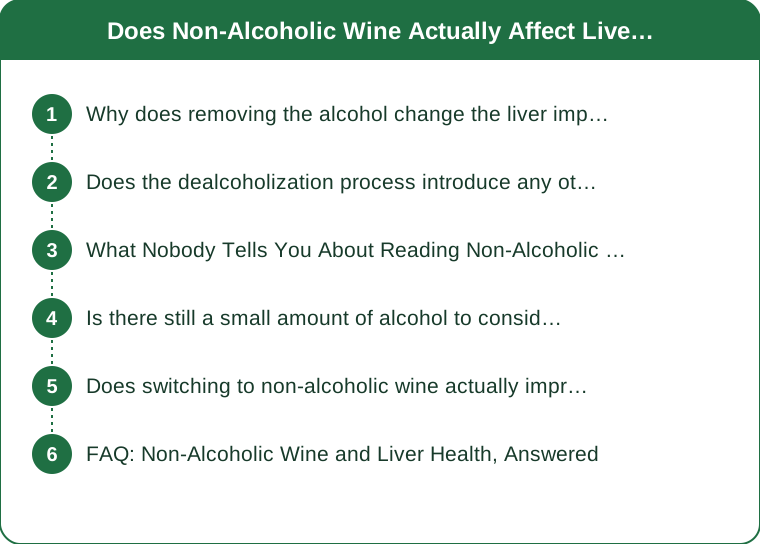
Why does removing the alcohol change the liver impact so significantly?
The liver’s alcohol-processing burden is specifically tied to ethanol content, which is what triggers the metabolic pathway that, over time and with heavy consumption, contributes to liver strain and fatty liver changes — dealcoholized wine’s residual alcohol content (usually under 0.5%) is too low to meaningfully engage that same metabolic pathway, making it a genuinely different liver-impact category, not just a marginally lighter version of regular wine.
Does the dealcoholization process introduce any other liver-relevant considerations?
Some dealcoholization methods can concentrate natural sugars or require added sugar to restore body and flavor lost when alcohol is removed, and higher sugar intake does have its own separate liver-relevant considerations (particularly for fatty liver risk from excess fructose) — so a sugar-heavy non-alcoholic wine isn’t automatically liver-neutral just because the alcohol is gone.
What Nobody Tells You About Reading Non-Alcoholic Wine Labels for Sugar
Sugar content varies significantly between non-alcoholic wine brands and styles, with some dealcoholized reds and whites containing noticeably more residual sugar than others depending on production method — checking the nutrition label rather than assuming all non-alcoholic wines are equivalently light is a reasonable habit for anyone specifically tracking liver-relevant intake.

Is there still a small amount of alcohol to consider for liver health?
Yes, technically — most non-alcoholic wine contains trace alcohol (generally under 0.5% ABV) from the dealcoholization process not achieving 100% removal, though this trace amount is far below the threshold research associates with liver strain, making it a non-issue for liver health specifically, even though it’s technically not zero.
Does switching to non-alcoholic wine actually improve measurable liver markers over time?
For people significantly reducing alcohol intake by switching, yes — measurable liver markers (like liver enzyme levels) commonly improve within weeks of substantially reduced alcohol consumption, and switching to a genuinely low-alcohol alternative that still delivers a similar drinking ritual can support that broader reduction more sustainably than simply willing yourself to drink less of the alcoholic version.
FAQ: Non-Alcoholic Wine and Liver Health, Answered
Is non-alcoholic wine safe for people with existing liver conditions?
Generally it’s a lower-risk choice than regular wine, though anyone with a diagnosed liver condition should still check with a doctor given individual variation in what’s appropriate, including the trace alcohol and sugar content.
Does non-alcoholic wine have any other health benefits linked to grapes themselves?
Some antioxidant compounds from grapes are retained in dealcoholized wine, though the overall research on meaningful health benefit from moderate wine consumption already has significant caveats independent of alcohol content.
Can pregnant women safely drink non-alcoholic wine given trace alcohol content?
Many guidelines suggest caution given the technically non-zero alcohol content, so checking with a healthcare provider for individual guidance is the safer approach rather than assuming ‘non-alcoholic’ means truly zero alcohol.
TL;DR:
- Non-alcoholic wine’s low alcohol content is too low to trigger the liver strain regular wine can cause
- Sugar content from dealcoholization varies by brand and is worth checking on the label
- Trace alcohol (under 0.5%) remains but is far below levels linked to liver impact
- Switching can support measurable liver marker improvement as part of broader alcohol reduction
It’s a genuinely lighter choice for liver health, with sugar content being the main remaining variable worth paying attention to.
Keep Reading
This article is for general informational purposes only and is not medical advice. Always consult a qualified health professional for guidance specific to you.